What's in a name? 🇹🇼
Plus: social prescribing, The Republic of Slowjamastan, potatoes for chips

CONTENTS
the tanjennt: what's in a name?
self-promo: source requests, last week's paid newsletter
links: to explore, coffee notables
inspiration & updates

What’s in a name?
I’m usually not one to jump on coffee news as it’s breaking, but this one is a little more personal. If you didn’t already know, I’m Taiwanese-American. I’ve written before about some of my cafe visits there, as well as some of the funeral rites I participated in. My parents immigrated from Taiwan to the US and are now naturalized citizens. Growing up in two places (Florida & Illinois), I was often the only Asian person in the class. If asked where I was “really” from, and I said Taiwan, the response would be, "I love Thailand!" or, “never heard of it.” And this was at the time when MANY of the items used and worn had “Made in Taiwan” on their labels.
Because of the pressure to assimilate and be that “model minority,” I learned about my cultural traditions and roots through pieces—Chinese (language) school, the most important holidays, and whatever my parents shared with me. Taiwan has its own flag, culture, governance, passport, etc.—all the makings of the sovereign country that it is—yet China has always claimed it as its own.
In coffee, there’s been a biiiig increase in Taiwan’s visibility on the world stage. Coffee is grown there on Alishan, roasters are buying some of the most expensive green lots, loads of specialty cafes are present, Taiwan Coffee Association has existed for 19 years, many innovations in manufacturing and coffee equipment were launched, there have been multiple championship stage appearances and wins in coffee competitions, with the latest being Bala in the World Latte Art Championship earlier this month. I remember when Berg Wu won the 2016 World Barista Championship, then Chad Wang won the 2017 World Brewer's Cup Championship; it felt like a turning point for the Taiwanese coffee industry.
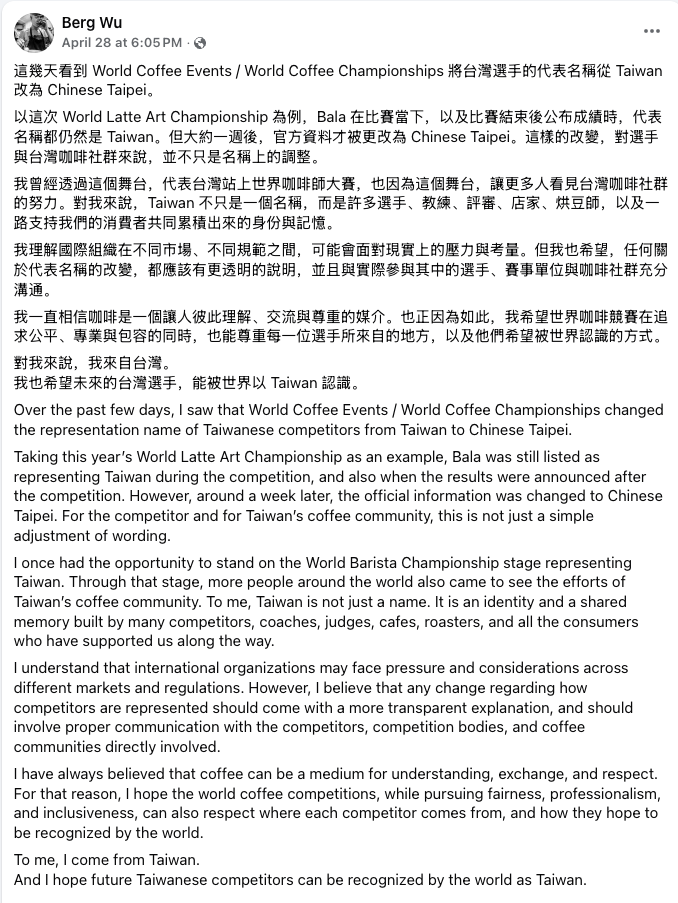
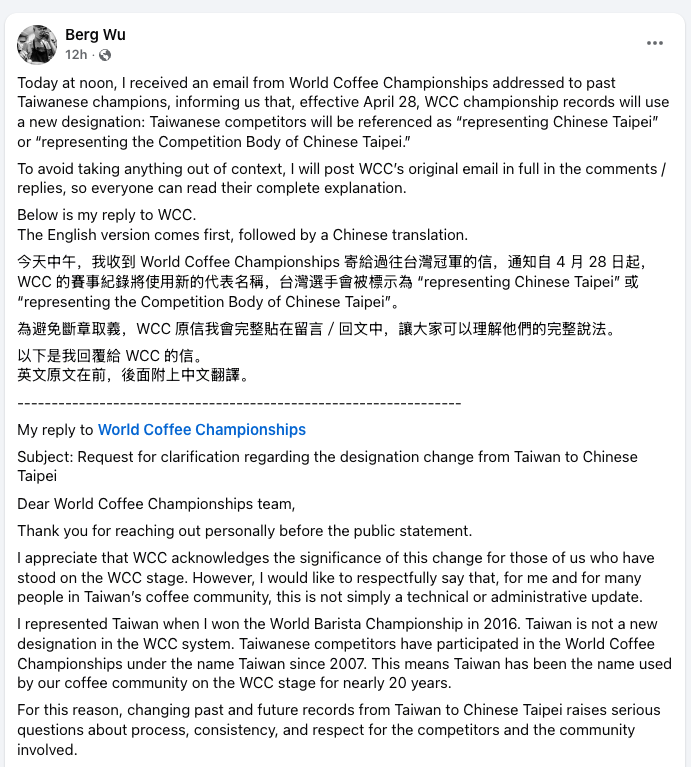
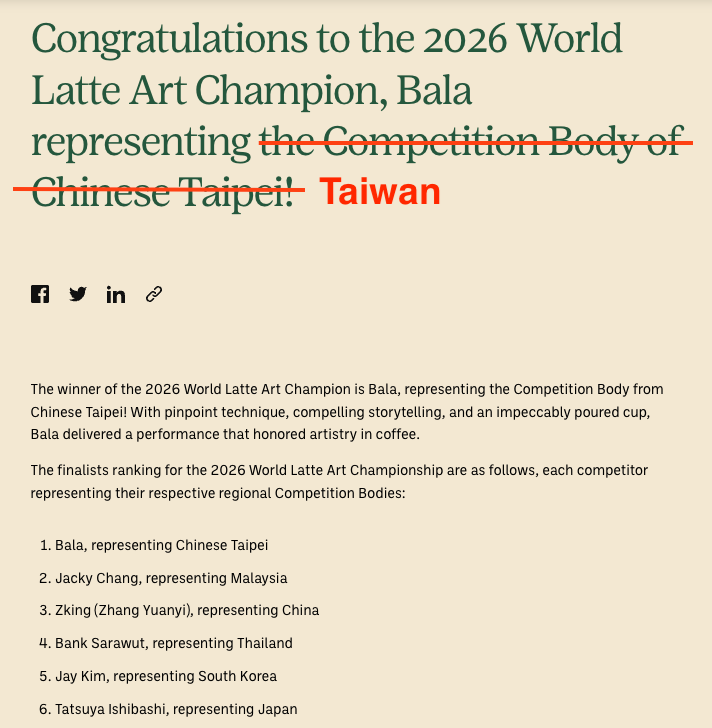
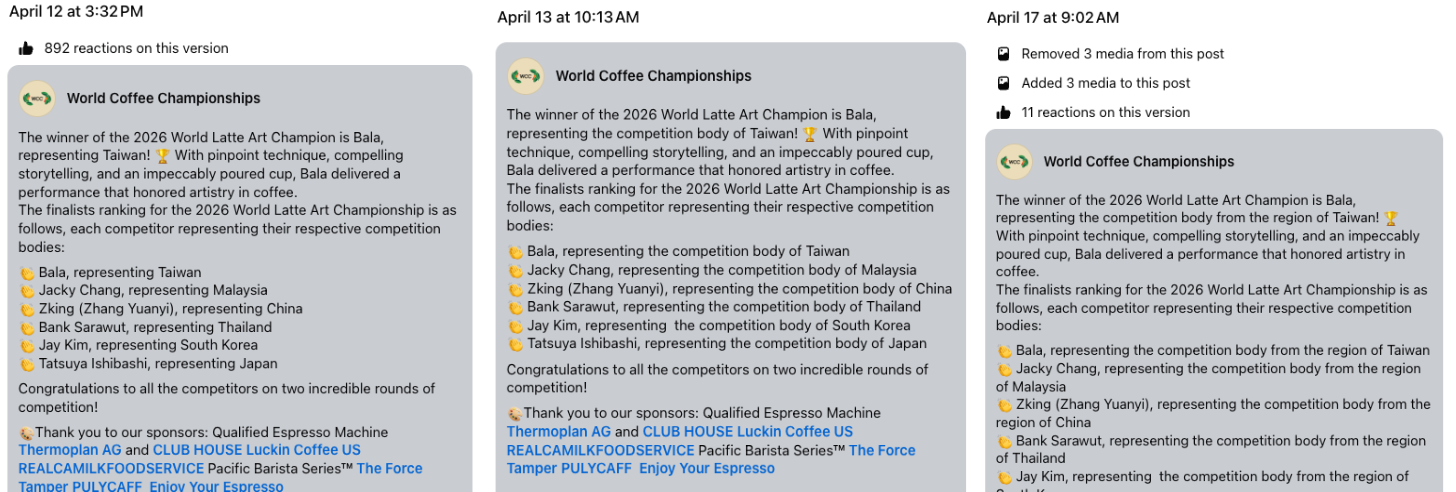
The news I mentioned at the beginning—if you haven’t already seen the posts of outrage on social media—is about how the World Coffee Championships (WCC) quietly changed all mentions of Taiwan in its social media, website announcements, and competition body listing to “Chinese Taipei” or “region of Taiwan.”
Did you know that Facebook post edits are public?
First announced by the Taipei Times, it alluded to the influence of Chinese cafe chain Luckin Coffee’s sponsorship, which didn’t quite track because that logo is too dang small on the banners to have much influence.
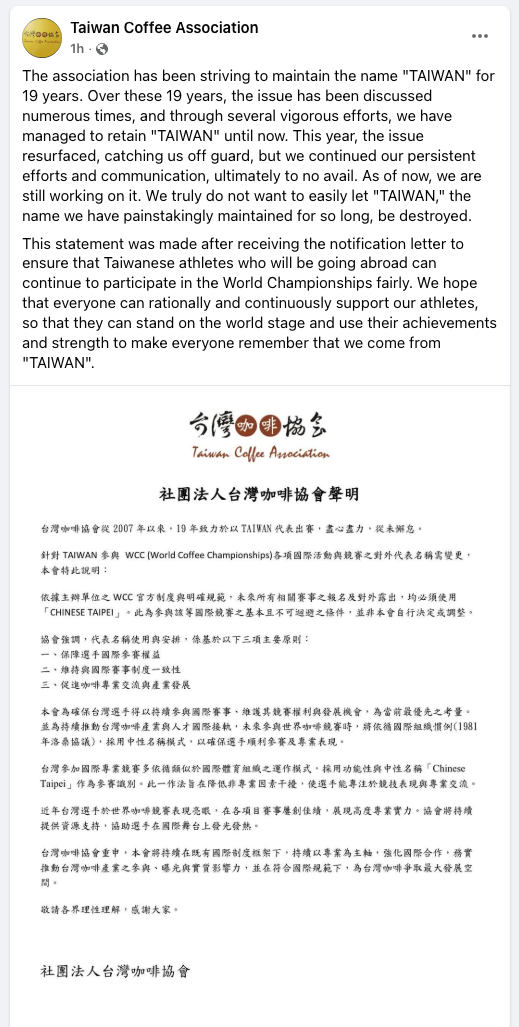
A bit later, the TCA posted on Facebook about the forced name change by WCC on the competition stage, so it matches how the country is registered with international sports competitions. Except…coffee competitions are not sports competitions. (Sprudge reported more on this; I did not have any influence on it.)
Added on May 1 / From WCC’s May 1, 2026 statement:
Effective April 28, the World Coffee Championships (WCC) will designate competitors as representing the Competition Body of Chinese Taipei, in alignment with the naming conventions used by international sporting bodies including the International Olympic Committee (IOC) and FIFA. This is an update to how competitors are recorded, administratively. It does not change who can compete, how they qualify, or the experience they have on the WCC stage.
It’s a bullshit, spineless move, doing it silently and hoping that no one notices. The erasure of Taiwan means less visibility of the country on the proverbial coffee world stage, brushing aside all the inroads and contributions it has made, and sets a dangerous precedent on SCA’s end. I’m also not particularly surprised that this is happening, given China’s moves in the specialty coffee space. The clearest reason for changing a country’s name is that someone else pressured them to. Perhaps a deal was struck in which this change was required for the deal to move forward.
Everything is political.
It’s a shame that WCC didn’t announce any of this, because you know, one of its values is “Purpose: To celebrate the craft of coffee by inspiring, engaging and fostering communities worldwide. We provide a platform for recognition, innovation, and growth through events that are accessible and relevant to everyone along the supply chain and at every skill level.” (Emphasis mine) Only certain communities, though.
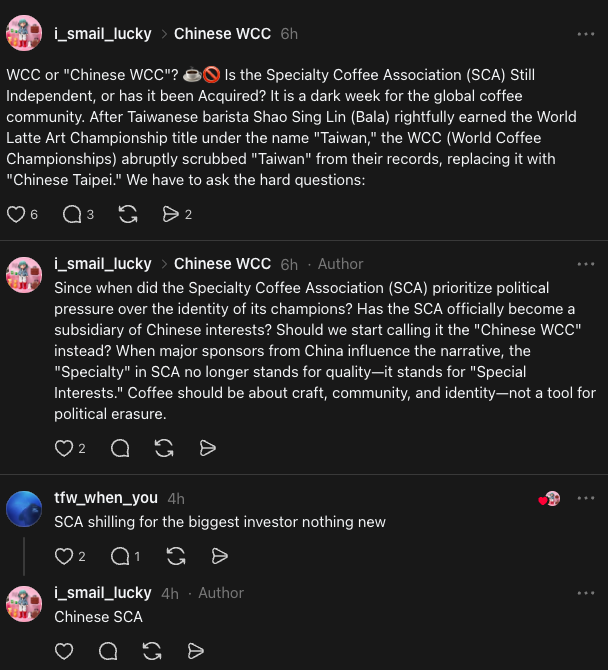
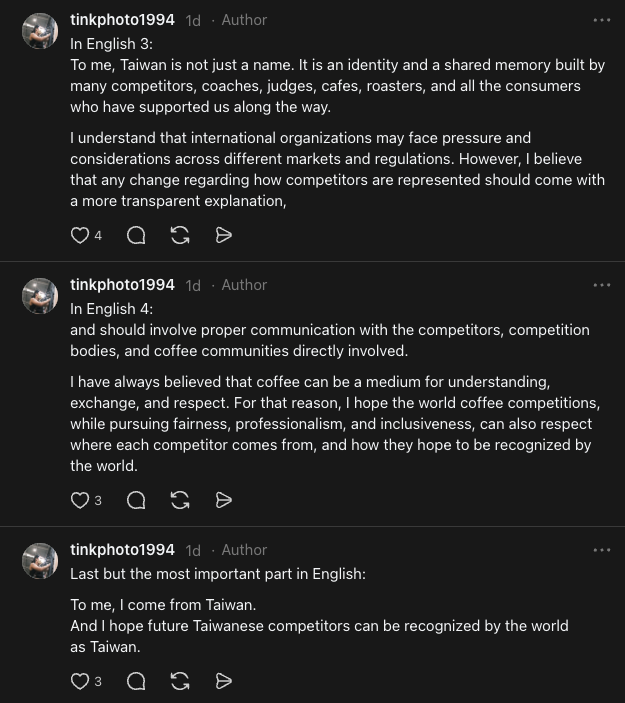
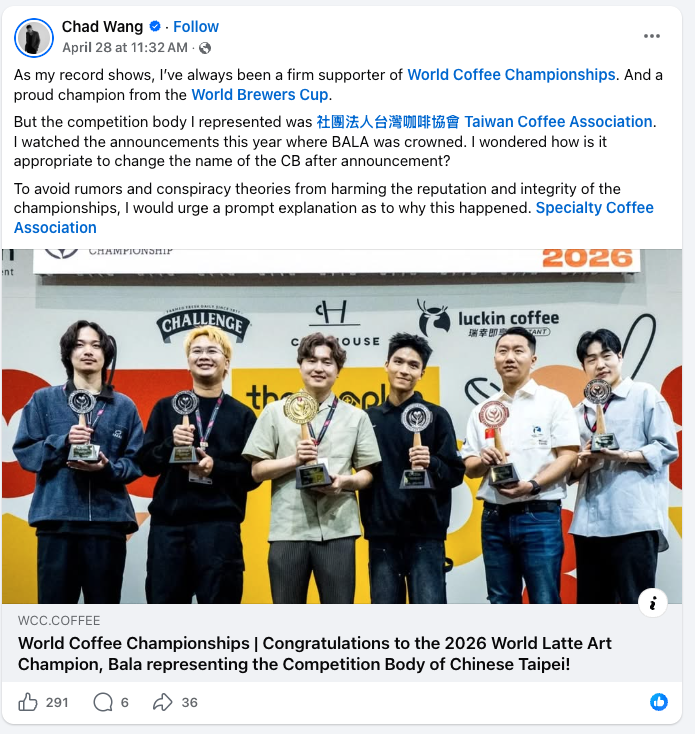
Thread 1, Thread 2, Facebook post (2017 World Brewer's Cup Champion)
May 1, 2026 at 11:30 am (UTC-7): This has been updated to include the statement WCC released this morning & Berg Wu's newest post. Additional commentary from me below:
WCC writes, “We know that administrative decisions, however technical, can feel personal, especially when they touch on identity and belonging.” So they kind of know why there’s an outcry. An “administrative” and “technical” decision makes it sound like it would make “administrative” work easier. What administrative work, you may wonder? It doesn’t say. Why is it aligning with the Olympics and FIFA? And if it’s “how competitors are recorded, administratively,” then wouldn’t it make everyone’s lives easier to keep it the same? Finally, “Effective April 28” and “will designate” can be interpreted as “moving forward,” NOT backdated, as it has been. Just say what you actually mean: it's a political decision. (After all, that "Chinese Taipei" designation to be "in alignment" with world sports originated from politics.)
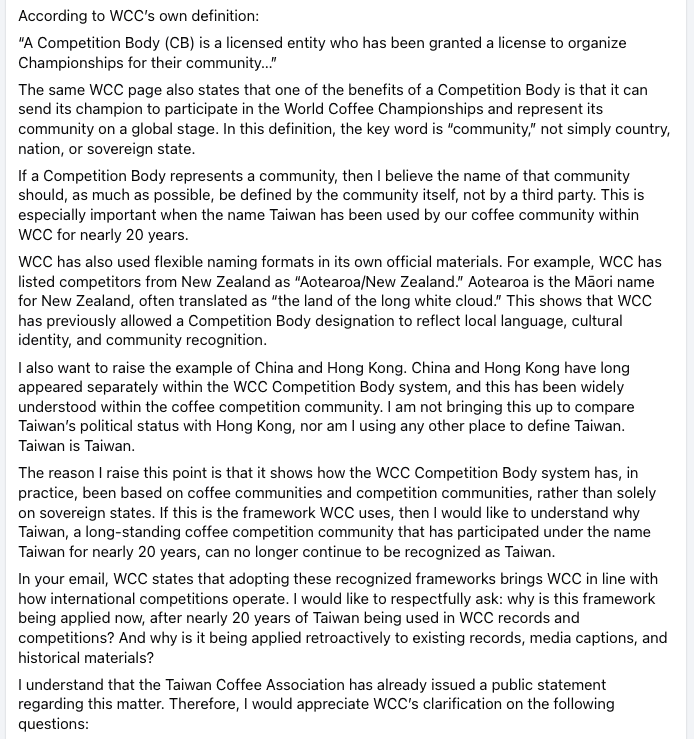
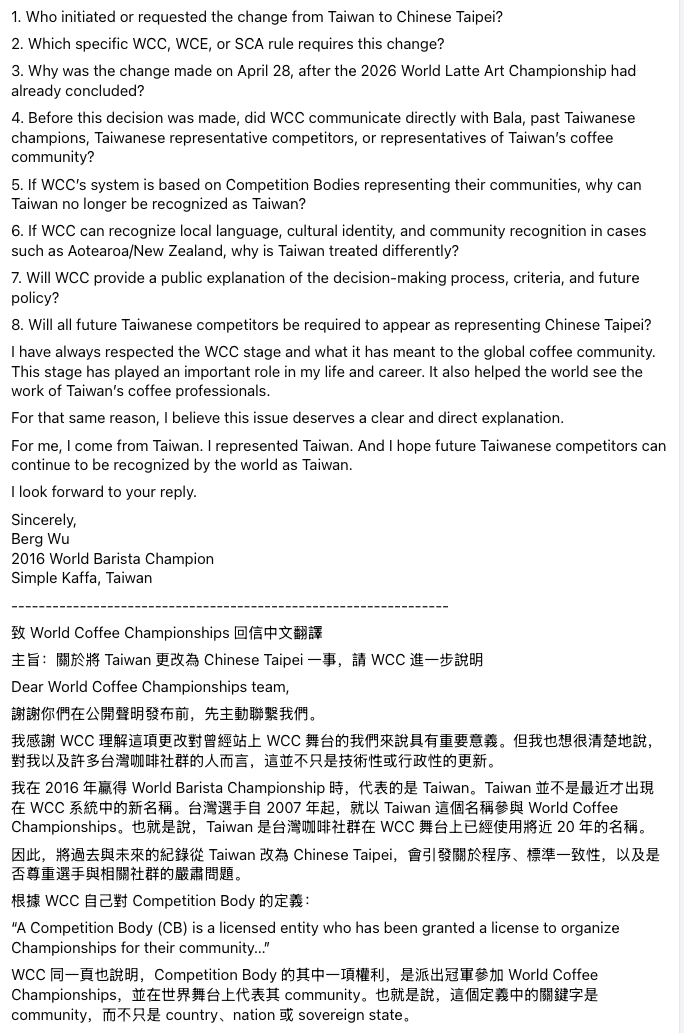
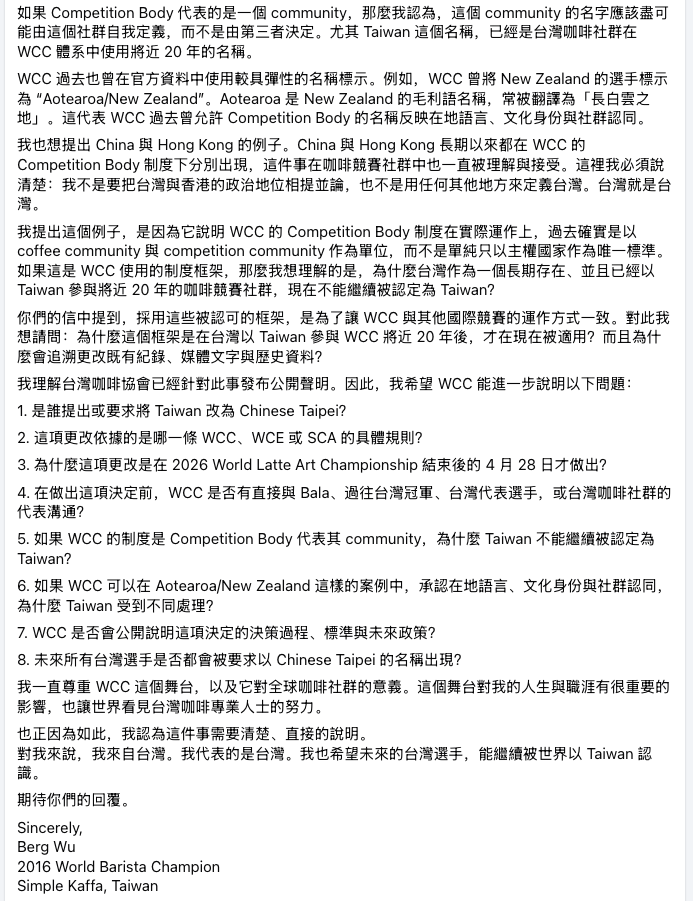
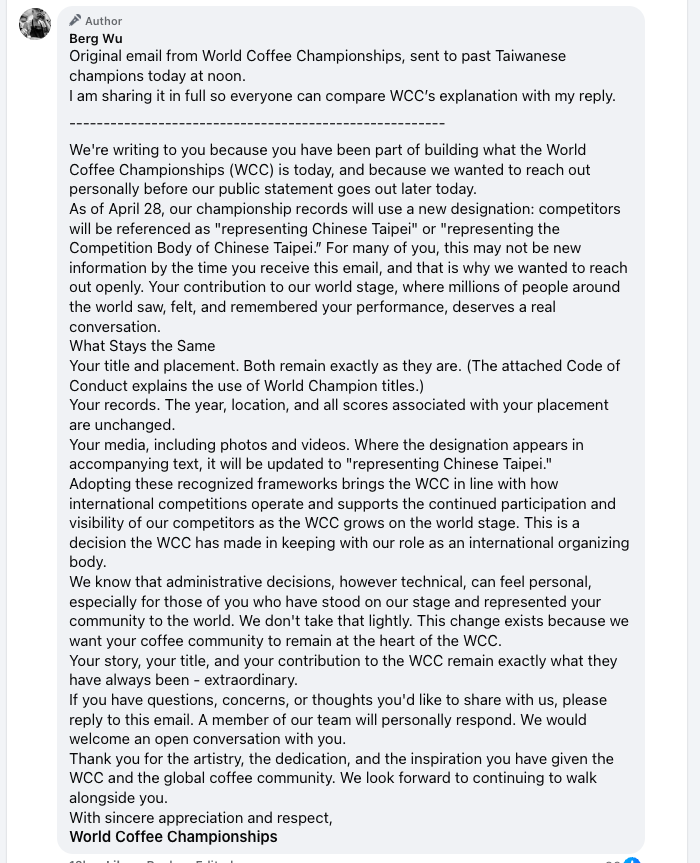
Berg Wu also released the emails he received and the ones he sent, posted on Facebook: