🔎 In Focus: Interview with Fionn Pooler, writer of "The Pourover"
"The reader should understand where I'm coming from, but also that these ideas that I'm presenting to them are measured and have been thought through."

CONTENTS
the tanjennt: an interview with Fionn
self-promo: source requests, last week's paid newsletter
links: to explore, recs
inspiration & updates

🔎 In Focus: Fionn Pooler, writer of "The Pourover"
It’s not every day that you’re granted to be someone’s first-ever full interview. The thing about writers who interview others is that we love our control. We control the conversation, we have the research and questions ready, and we’re asking the follow-up questions. When you flip it back to us, I can’t say it’s the most enjoyable experience. But who better to end my big break in In Focus interviews than Fionn Pooler, another writer who interviews people and writes a newsletter (The Pourover).
We chatted about coffee, of course, but also living in Michigan, writing, being a barista, and diner coffee. Next week, paid subscribers will receive bonus interview content that expands on his outlook of The Pourover’s future.
Fionn (pronounced “fin”) is half-Scottish, half-American. “I have both passports, which is a blessing and a curse it turns out, because I still have to file taxes in America the rest of my life, despite not living there anymore.” He’d always wanted to live in the US, especially California where his dad is from, and naturally, as one does, ended up in Ypsilanti, Michigan. It’s a small town in the meaty part of the hand, south of Ann Arbor 💬.
“I found it so different from where I was before, in Scotland, and I really like the people. I like the openness,” he adds. “There's a lot about Michigan I felt was really under-appreciated.”
He moved to Michigan with some previous coffee experience under his belt. After supplementing a front-of-house theater job with a barista job, Fionn eventually convinced a cafe owner to teach him how to roast. He notes, “I kind of fell into coffee; I think it’s pretty standard for a lot of people.” His Coffee Origin Story is tasting a natural Ethiopian espresso—an experience that many of us who fell into coffee in the aughts had—but it was never a hobby for him, and has “always been a career.”
Fionn is now back in Scotland after his decade in Michigan. He began his newsletter, The Pourover, when he was still in the US. While The Pourover is technically about coffee, he goes beyond that by writing deeply researched articles twice a month and shorter ones for his paid subscribers twice a month. In addition, he writes a weekly roundup of coffee news articles for Fresh Cup. Answers have been edited and condensed for clarity.

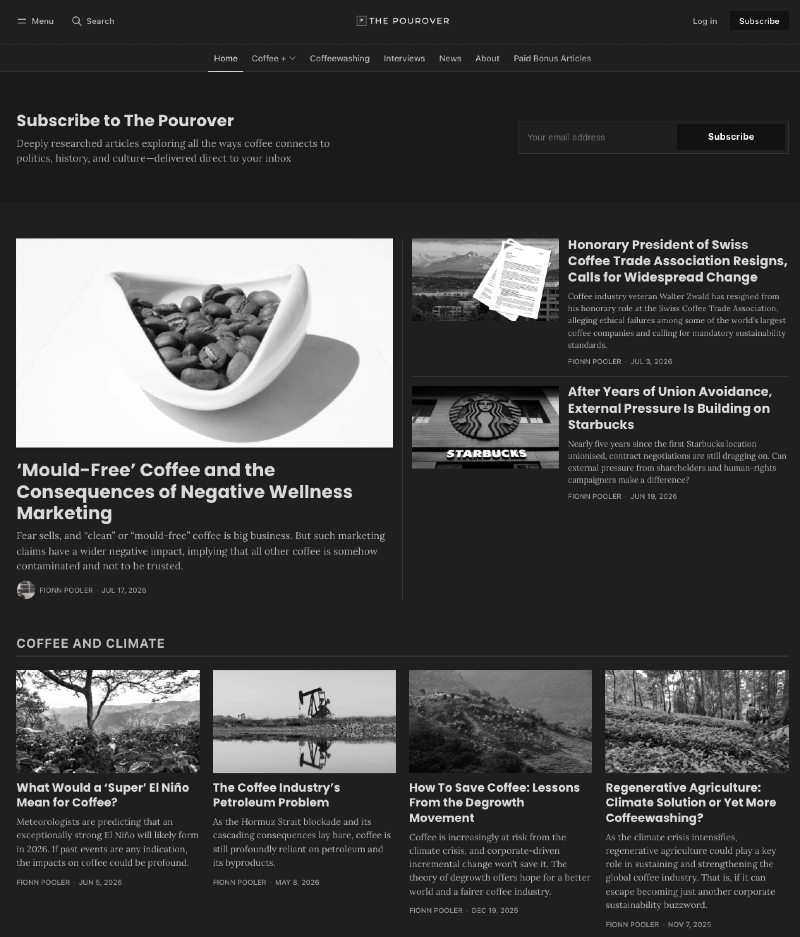
The Pourover’s dropdown menu includes a “Coffee +” with selections like “Politics,” “Unions and Labour,” and “Corporations.” Many of the articles are on topics that are rarely seen in other industry trade publications and I’m linking a few of my favorites at the end of this interview.
Jenn: How has it been living there but still covering a bunch of US news?
Fionn: It's funny because my audience for my newsletter is majority American, still, because I started it properly while I was in America. The coffee culture in America is much more dominant, I feel, especially when it comes to news. Things are happening in America—all the big companies are there. I write for Fresh Cup, they're American; for Sprudge occasionally, they're American. Switching back and forth between American and English spelling is a bit confusing but I'm learning. The time zone is a pain but that's just the reality of it. Generally speaking, the stuff that I'm interested in writing about is much more global.
What is something that bothers you when you do interviews with people?
Can it be things that I do wrong? Because that's usually how I feel. I don't want them to waste their time, so I always feel really bad that I'm making them do this, even though most people are really happy to chat. I've had interviews that have gone on for like an hour and a half and I try to figure out how to how to stop this.That's what bothers me, mostly, is myself not being able to drive the conversation in the way that gets the quotes that I need. I obviously can't throw stones, because I'm not a particularly good communicator either, verbally.
Would you ever want to expand beyond covering the coffee industry?
Something that in one of your interviews, I think it was with Ever Meister (it was), and they talked about the thing that's changed for them is being less interested in coffee as a drink. It's tasty. I'm not really into flavor and sensory stuff, I'm not good at it, and don't really find it particularly interesting. Coffee is way more than that and so yes, I would expand beyond coffee, but there's so much still in coffee that I haven't explored, I haven't written about. The coffee industry is vast and the history of it is bananas. There's some really dark stuff, really interesting, and really powerful stuff happened that isn't known about beyond people like us. And so I'm not tired of it; I’m not bored.
Something that you mentioned recently about email interviews and the possibility of people using AI chatbots to answer—I’ve been hyper aware of that, trying to do more in-person interviews even though it's a lot more work.
On his writing process
Astoundingly, he mostly works on a two-week cycle, which means within two weeks, he researches, interviews, and writes one article. Writers often work on multiple pieces at a time, but he’s found that it’s been too difficult (same for me). The context switching is burdensome.
What is your general writing process like?
This is my second attempt at freelancing, I started it in January 2025. I am very envious of the way—when you write about this in your newsletter—the tools you use and the way you've organized everything. I am not organized in my writing.
I can't tell.
My planning, it's seat of the pants stuff a lot of the time, like I find it very difficult to focus on different stories at the same time. I can do it as far as some researching and a bit of planning, but I can't write more than one article at a time. I find my brain struggles with it.
At one point, he found himself doing three articles at once. His editor Claire took a month off to get married, so he submitted two Pourover articles to her and was also writing another for Fresh Cup. “My brain was mush by the end of it because they were all quite complicated,” he says about the topics. “Switching back and forth between them, I found really difficult. But that’s, I think, what people do; so maybe I should be better at this.
I can't help you here. I can only do [write] one at a time.
Just before I came on this call, I was writing an article for my paid subscribers' bonus articles which are supposed to be little short 500 words and I had fifty tabs open on my other window just because I’m constantly finding additional documentation. I cite probably too heavily, I guess. I tend to go get really, really deep into the research part of things and then writing—sometimes it can be a struggle, but usually if I power through the first draft, it's fine. If I can get the first draft in any way coherent, then I'm happy.
So does that mean you do like phases for an article, like research and then write, or do you research while writing?
I usually research heavily first, and then I write. For my own writing, I basically will spend a day or two, sometimes longer, researching, and that can include interviews. A lot of the time, it's tracking down sources, organizing that, and trying to get responses. I find that I read a lot, as much as I can about the topic—studies and articles, whatever it is—helps me absorb as much as I can, and then I try to organize my thoughts.
A lot of time I have to go for a walk. Luckily, I live in the Highlands of Scotland, so I have very beautiful scenery and I can just go and be in the woods for an hour or so, and that tends to help me formulate things in my head about the article. My articles definitely have an opinion behind them, but I try to be quite fair or measured in what I write.
The reader should understand where I'm coming from, but also that these ideas that I'm presenting to them are measured and have been thought through.
What unfortunately ends up happening is that it takes me so long to get to the point where I'm actually writing it, that I'm always up against my self-imposed deadline to get these things done.
Oh, really? Oh, no.
Yeah, it's terrible. I'm trying to get better at doing things a week in advance—pushing it back a week so I have more time—but, yeah, I just fall back into where I put things off, or I struggle to find sources, and then I'm rushing. It'll be Wednesday night, and I'm supposed to be getting the article to Claire, and I'm desperately trying to get it done. Which is really silly, because it's my self-imposed [deadline]. This is my newsletter—I can do what I want, right?
Coffee hill, diner coffee
What's the coffee hill you would die on?
That’s the question people ask the at the at the SCA events, they ask what's your coffee hot take?
It doesn't need to be serious, either.
I should have thought about this kind of thing. I guess a hill I would die on—is that coffee sustainability in coffee is more marketing than it is anything else. But that’s not new; we all know that. I've been writing about this for years. Everything is marketing in coffee.
We briefly went on a tangent conversation here about pizza—how “there is almost no pizza I wouldn't eat. Even bad pizza is better than no pizza”—which I am definitely not in agreement with. There was also the age-old question of “is pizza a pie?” that we skipped on debating. Eventually, we landed on the beauty of diner coffee. Fionn notes, "I like coffee, but I'm not super picky. I like diner coffee. Diner coffee's great. That's a strong opinion."
I love diner coffee, too.
I’ve written about it. I think there's something very special about diner coffee. Even if it’s bad; it’s usually bad.
I feel like the definition of it is it's bad.
I wrote an article about a diner in, I can't remember, a few years ago. And they were doing Chemex pour-overs.
Was that still a diner at that point?
I don’t know. What do you define as a diner? It was in one of those cars, like an old train car kind of thing, like it was a proper old school diner. Is that diner coffee? Technically it is because it's in a diner and you're drinking it and it's coffee. It's probably in a diner mug. But I don't know—that's the question—what defines diner coffee?
I honestly think a good part of being in a diner is the watered-down coffee in the diner mug. And if you have Chemexes being made for you at a diner, that kind of—
Defeats the purpose.
Yeah, and also, I feel like that kind of coffee doesn't pair very well with the diner food.
I don’t think they were making the fanciest coffee in the world. It was probably like, you know, low to medium to specialty grade. But it wasn't like they weren't doing 90+ coffees and serving those with pancakes or whatever. But yes, I think diner coffee is incredible and it's one of the things I miss the most about America, genuinely, going to diners.
I don't really eat in restaurants very much anymore, but, yeah, that was one of my favorite things to do when I lived in Michigan—to go to truck stops or any kind of like roadside diner or anything.
Thank you, Fionn, for sharing about your life, your writing, and your love of diner coffee. And, especially, for trusting me to be your first full interview. As mentioned earlier, I’m linking a few of his articles that I’ve enjoyed reading below.
 Fionn Pooler
 Fionn Pooler
 Fionn Pooler
In Focus is an ongoing interview series in which I converse with coffee and coffee-adjacent creatives. I welcome nominations in my inbox, especially if they are based outside the US. Next week, paid subscribers will receive bonus interview content covering Fionn’s Pourover plans, writing, and difficulties in finding sources.